

Strategies for Winning in the Dynamic Consumer and Retail Sectors of the Gulf.
Consumer companies in the Middle East can stay competitive by focusing on two main areas: expanding into new related markets and creating personalized products and services to meet changing consumer demands.

As the pandemic and economic challenges continue to affect the Gulf region, a new type of consumer has emerged. They are more price conscious, digitally savvy, and socially responsible. This shift in consumer behavior started during the peak pandemic months and is expected to continue influencing spending decisions in 2022 and beyond. This change should be a wake-up call for retailers and consumer-packaged-goods manufacturers who were previously riding a wave of growth without the need to experiment with new products and services. To stay competitive in this dynamic environment, companies should focus on putting consumer data at the heart of every business decision and prioritize expanding into new products and businesses that better align with evolving customer needs. Additionally, personalized marketing initiatives should be developed to retain customers. Those who do not pursue these new strategic priorities risk falling behind in a rapidly changing market.

The new Gulf consumer
According to our survey of over 2,200 consumers in the Kingdom of Saudi Arabia and the United Arab Emirates, conducted in November 2021, Gulf consumers are becoming more price sensitive. The ongoing economic uncertainty, job insecurity, and prolonged pandemic have led to more than 50% of consumers in both countries cutting back on their spending. Consumers are looking for cheaper grocery options that offer similar quality, with a significant change observed in lower-income groups. For example, in the UAE, 27% of low-income respondents earning less than 7,000 AED ($1,905) annually opted for lower-priced goods in 2021, up from 13% in 2020.
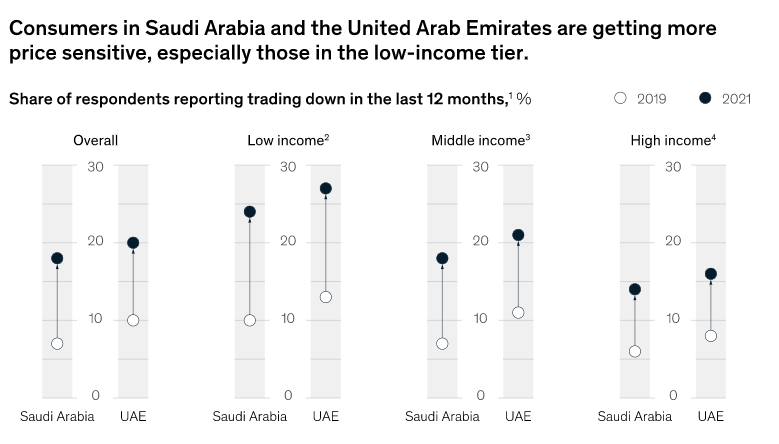
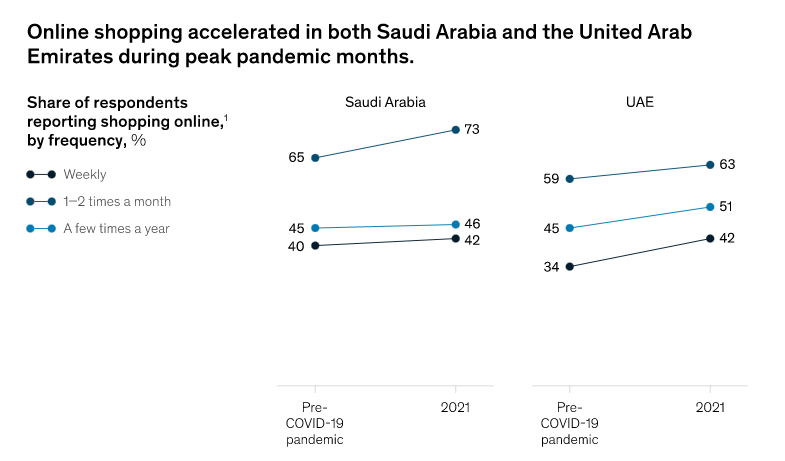
Consumer behavior in the Gulf region is shifting, as price sensitivity, digital savvy, and social responsibility become more important factors in purchasing decisions. This change has been accelerated by the pandemic and is expected to continue in the coming years. To stay competitive, retailers and consumer-packaged-goods manufacturers must adapt by expanding into new adjacencies and developing personalized offerings. Gulf companies that fail to do so risk losing customers to competitors. A recent survey of more than 2,200 consumers in Saudi Arabia and the United Arab Emirates found that consumers in the region are becoming more price sensitive and digitally oriented, with a growing number shopping online for a diverse range of products.
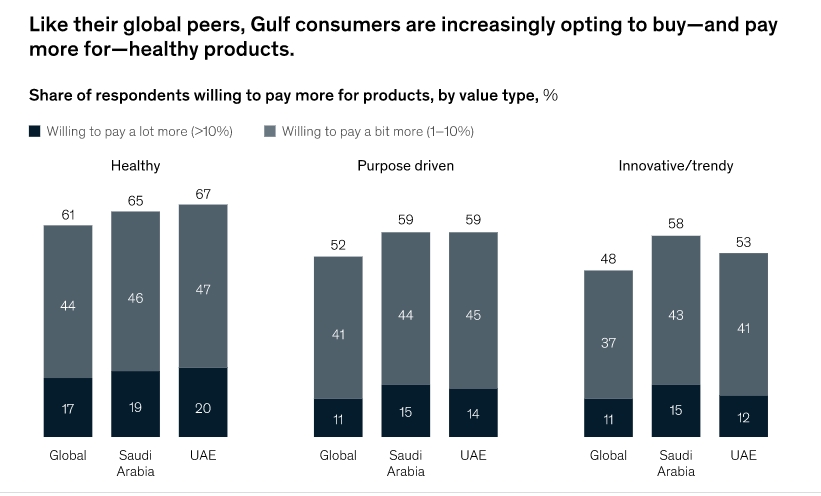
Gulf consumers are becoming more savvy in their shopping habits and are prioritizing health, purpose, and social responsibility when making purchasing decisions. This aligns with the global trend of consumers placing greater emphasis on sustainability and well-being. Conscious eating is becoming more popular, with more than half of UAE-based consumers reading nutrition labels and almost half buying locally sourced food. Millennials, in particular, prefer brands that use sustainable packaging.
New consumer behaviors, new growth imperatives
Consumer preferences are constantly changing, and it's up to omnichannel retailers and CPG manufacturers to keep up with these shifts. Price sensitivity among lower-income households has accelerated due to the pandemic, while trends like a focus on health and nutrition have been in motion for a few years.
Consumer data is now the most valuable growth driver for Gulf consumer companies, but many companies are slow to execute due to a lack of digital preparedness in their IT infrastructure and overall culture and talent capabilities. While 73% of Gulf consumer companies' family businesses in a 2019 McKinsey survey said they collected and tracked data, there were issues with data access and accuracy, with 50% of respondents claiming significant inaccuracies in their data.
Consumer data is now the most valuable growth driver for Gulf consumer companies, but many companies are slow to execute due to a lack of digital preparedness in their IT infrastructure and overall culture and talent capabilities. While 73% of Gulf consumer companies' family businesses in a 2019 McKinsey survey said they collected and tracked data, there were issues with data access and accuracy, with 50% of respondents claiming significant inaccuracies in their data.
Although certain trends, like a heightened emphasis on health, nutrition, and purpose, have been developing for a few years, the pandemic has accelerated the price sensitivity among lower-income households.
Although certain trends, like a heightened emphasis on health, nutrition, and purpose, have been developing for a few years, the pandemic has accelerated the price sensitivity among lower-income households.
Expand into adjacencies and new businesses
Retailers in the Gulf region have traditionally grown their businesses by acquiring other companies or forming partnerships. But now, some retailers are exploring new approaches to take advantage of opportunities, particularly in the digital arena. They're considering creating new products, services, or business models from scratch, known as business building. This approach has gained popularity during and after the pandemic. More than half of the organizations surveyed placed new business building among their top strategic priorities.
Expand into adjacencies and new businesses
Retailers in the Gulf have traditionally grown their businesses by buying other companies or forming partnerships. However, some retailers are now thinking outside the box and exploring new ways to seize opportunities in the digital world. They're considering creating new products, services, or business models from scratch, which is called business building. This approach has gained momentum during and after the pandemic. Over half of the organizations surveyed have identified new business building as a top strategic priority.
Business building can help companies diversify their revenue streams, achieve scale, and increase their resilience, especially during times of crisis. A survey showed that 74% of global companies that prioritized business building in 2020 grew at rates above their industry average. Companies that built four or more businesses had double the chance of earning a return on investment of five times their initial investment, outperforming their peers.
In the Middle East, retailers and CPG manufacturers have access to long-term financing from Gulf sovereign-wealth funds and overseas investors. Governments in the region are also creating more job opportunities and expanding digital initiatives, making it an ideal environment for business building.
Creating new businesses allows companies to take advantage of changing consumption and macro trends in the global economy. The growing focus on sustainability, for instance, has led to increased demand for plant-based products. In 2020, the plant-based meat and dairy products market in the Middle East and Africa was valued at $240 million and is projected to achieve 6% CAGR between 2021 and 2026.
One Gulf-based retailer used a business building approach to create a new digital advertising business in 2021, generating additional revenue for its e-commerce business and improving overall profitability. The retailer hired digital experts to run the advertising
In the Middle East, retailers and CPG manufacturers have access to long-term financing from Gulf sovereign-wealth funds and overseas investors. Governments in the region are also creating more job opportunities and expanding digital initiatives, making it an ideal environment for business building.
Creating new businesses allows companies to take advantage of changing consumption and macro trends in the global economy. The growing focus on sustainability, for instance, has led to increased demand for plant-based products. In 2020, the plant-based meat and dairy products market in the Middle East and Africa was valued at $240 million and is projected to achieve 6% CAGR between 2021 and 2026.
One Gulf-based retailer used a business building approach to create a new digital advertising business in 2021, generating additional revenue for its e-commerce business and improving overall profitability. The retailer hired digital experts to run the advertising

Pursuing personalized marketing
In today's competitive business landscape, companies in the Gulf region can use data-enabled personalization to attract and retain loyal customers. Personalization uses customer data, such as demographics and purchase history, to optimize the timing, content, offer, and design of every customer experience. This approach helps develop differentiated marketing and communication strategies tailored to individual customers.
According to a survey, personalization can typically drive a 10 to 15 percent revenue increase for companies on average. Moreover, personalization can help develop a pricing, brand, and marketing strategy that caters to different consumer segments more strategically. For instance, a company can allocate a bigger portion of their marketing budget towards custom discount bundles for low-income households that are exhibiting the biggest changes in consumption behavior.
According to a survey, personalization can typically drive a 10 to 15 percent revenue increase for companies on average. Moreover, personalization can help develop a pricing, brand, and marketing strategy that caters to different consumer segments more strategically. For instance, a company can allocate a bigger portion of their marketing budget towards custom discount bundles for low-income households that are exhibiting the biggest changes in consumption behavior.
To keep revenue growth during the pandemic-induced slowdown, a Middle Eastern retailer developed a team dedicated to personalized marketing efforts. They tailored their communication campaigns to send millions of personalized messages to their customer base every week and continuously tested to refine their approach. Their personalized marketing campaign resulted in an 8 to 10 percent revenue uplift compared to mass campaigns or no campaigns at all. As consumer behaviors and expectations change quickly, it is important for companies to take action and develop capabilities for business building and personalization to remain resilient and productive, even during potential economic downturns.

WE'RE HERE TO HELP
We're ready to
Grow your business
Unlike traditional consultants, our team are experienced implementers who have a track record of successfully driving growth for small and medium businesses. We not only provide guidance, but also take pride in sharing our knowledge and expertise with others.